
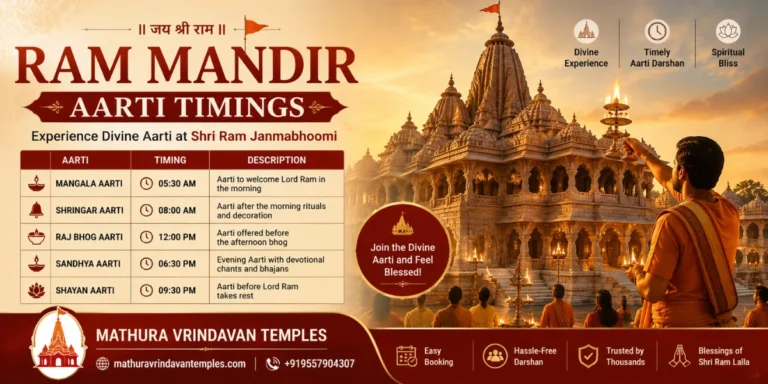
Ram Mandir aarti timings follow five daily ceremonies — Mangala Aarti around 4:00 to 4:30 AM, Shringar Aarti near 6:15 to 6:30 AM, Bhog Aarti at midday, Sandhya Aarti in the evening between 6:00 and 7:30 PM, and Shayan Aarti between 9:30 and 10:00 PM. Mangala, Shringar and Shayan Aarti require a free pass booked at online.srjbtkshetra.org, while Bhog and Sandhya Aarti are generally open to all devotees. Timings shift with season and festival days, so verification before travel matters.
I want to start this guide with something most articles will not tell you. If you search Ram Mandir aarti timings today, you will find half a dozen websites confidently listing different schedules — one says Mangala Aarti is at 4:00 AM, another insists 4:30 AM, a third places Sandhya Aarti at 6:00 PM while others say 7:30 PM. They cannot all be right. Having booked passes for pilgrim families at this temple every single day for two years, I can tell you why the confusion exists and, more usefully, how to plan around it so you actually reach the aarti you travelled for.
Table of Contents
ToggleWhat Are the Ram Mandir Aarti Timings in 2026?
The Shri Ram Janmabhoomi Mandir conducts five principal aartis through the day, each marking a stage in Ram Lalla’s divine routine — from being woken before dawn to being put to rest at night. The table below reflects the schedule as commonly followed, along with the honest range you will encounter across sources.
| Aarti | Timing Range | Pass Required | Best For |
|---|---|---|---|
| Mangala Aarti | 4:00 – 4:30 AM | Yes | Devotees seeking the most sacred moment |
| Shringar Aarti | 6:15 – 6:30 AM | Yes | Morning visitors, families |
| Bhog / Rajbhog Aarti | Around 12:00 PM | Generally not | Midday devotees |
| Sandhya Aarti | 6:00 – 7:30 PM | Generally not | Evening visitors, largest attendance |
| Shayan Aarti | 9:30 – 10:00 PM | Yes | Overnight visitors, quiet experience |
The variation you see is real, not sloppy reporting. Aarti timings at Ram Mandir shift with the season, with sunrise and sunset, and significantly on festival days. The temple trust adjusts them as required. This is precisely why I tell every traveller to confirm the schedule close to their travel date rather than trusting a figure they read three months earlier.
In short: Ram Mandir holds five daily aartis — Mangala, Shringar, Bhog, Sandhya and Shayan. Mangala, Shringar and Shayan need a free pass; Bhog and Sandhya are usually open. Timings vary seasonally, so verify before travelling.
What Happens at Each Ram Mandir Aarti in ayodhya?
Each aarti carries its own character, and knowing what actually happens helps you choose which one suits your journey rather than picking blindly.
Mangala Aarti at Ram Mandir
Mangala Aarti is the awakening ritual, performed in the pre-dawn darkness around 4:00 to 4:30 AM when Ram Lalla is roused for the day. In my experience this is the most spiritually charged moment available at the temple — the complex is quiet, the crowd is small and screened, and the sound of conch shells and bells carries in a way it simply does not at any other hour. It is also the hardest pass to secure anywhere in Ayodhya. Attending requires staying overnight within walking distance, since no transport operates conveniently at 3:30 AM, and reporting at the entry gate at least 30 minutes ahead.
Shringar Aarti at Ram Mandir
Shringar Aarti takes place in the early morning, most commonly cited around 6:15 to 6:30 AM, when the deity is adorned with fresh garments, ornaments and flowers. This is the aarti I recommend most often to families and elderly pilgrims who find the 4 AM timing genuinely difficult. The atmosphere is devotional but far more manageable, the temperature is comfortable even in summer months, and it sits perfectly before the 7:00 AM general darshan window, letting you complete both in one smooth morning.
Bhog or Rajbhog Aarti
Bhog Aarti happens around midday, when food is offered privately to Ram Lalla, and it is directly tied to the sanctum closure between roughly 12:00 PM and 2:00 PM. This closure catches out more first-time visitors than anything else — every week I hear from families who reached the gate at half past twelve after a long drive and stood in the heat waiting. Public participation in this aarti is limited compared to the others, so plan the midday window for Hanuman Garhi, a Sattvik lunch or rest instead.
Sandhya Aarti at Ram Mandir
Sandhya Aarti is the evening lamp ceremony, performed as the sun sets, with reported timings ranging from 6:00 PM to 7:30 PM depending on season and source. This is the most widely attended aarti at Ram Mandir, partly because it is generally accessible without a pass and partly because the temple looks extraordinary under evening illumination. Crowds are substantial, especially on weekends. Reaching 45 minutes to an hour early makes a real difference to where you end up standing, and pairs beautifully with the Saryu Aarti at Ram Ki Paidi afterwards.
Shayan Aarti at Ram Mandir
Shayan Aarti is the final ceremony of the day, held between 9:30 and 10:00 PM, when Ram Lalla is ceremonially put to rest and the temple closes for the night shortly after. It requires a pass, but availability is noticeably easier than Mangala Aarti because far fewer pilgrims stay in Ayodhya overnight. For travellers spending a night in the city who missed the pre-dawn booking, this is the quiet, intimate alternative I usually suggest.
Key takeaway: Mangala Aarti offers the most sacred pre-dawn experience but is hardest to book. Shringar suits families, Sandhya draws the biggest evening crowds, and Shayan Aarti offers a peaceful night option with better pass availability.
Which Ram Mandir Aartis Require a Pass?
This distinction matters more than the timings themselves, and remarkably few articles state it clearly. Mangala Aarti, Shringar Aarti and Shayan Aarti operate on limited seating and require a free aarti pass booked in advance through the official portal. Bhog Aarti and Sandhya Aarti are generally open to devotees without a separate pass, though entry is regulated during heavy crowd periods and festivals.
| Aarti | Pass Requirement | Booking Difficulty |
|---|---|---|
| Mangala Aarti | Pass mandatory | Very high — book at slot release |
| Shringar Aarti | Pass mandatory | High |
| Bhog Aarti | Generally open | Not applicable |
| Sandhya Aarti | Generally open | Arrive early for position |
| Shayan Aarti | Pass mandatory | Moderate — better availability |
The practical implication is straightforward. If your heart is set on Mangala Aarti, your booking has to happen the moment slots release. If you simply want to witness an aarti at Ram Mandir, Sandhya Aarti requires no booking at all — only an early arrival.
In short: Mangala, Shringar and Shayan Aarti need a free pass booked in advance. Bhog and Sandhya Aarti are generally open to all devotees without separate booking.
What Are the Ram Mandir Darshan Timings?
Aarti and darshan are separate things, and pilgrims searching for Ram Mandir aarti timings almost always need the darshan schedule too. General darshan of Ram Lalla runs from around 7:00 AM until roughly 11:30 AM, pauses for the Bhog closure between 12:00 PM and 2:00 PM, then resumes in the afternoon and continues into the evening. Sources place the evening cut-off anywhere between 7:00 PM and 9:00 PM, which again reflects genuine seasonal variation.
| Session | Approximate Timing | Crowd Level |
|---|---|---|
| Morning darshan | 7:00 – 11:30 AM | Low early, rising after 9 AM |
| Bhog closure | 12:00 – 2:00 PM | Sanctum closed |
| Afternoon darshan | 2:00 – 4:00 PM | Moderate |
| Evening darshan | 4:00 PM onwards | High, especially weekends |
The 7:00 to 9:00 AM window is what I call the golden stretch — calm, cool and quick. It is also why Sugam Darshan slots in that window vanish first every single day.
Practical summary: General darshan runs roughly 7:00 to 11:30 AM and 2:00 PM into the evening, with a strict midday Bhog closure. Morning is consistently the calmest window.
How Is Ram Mandir Aarti Different from Regular Darshan?
Devotees often assume an aarti pass covers darshan or the reverse. It does not. They are separate bookings serving separate purposes, and confusing the two is a common reason people miss what they came for.
| Feature | Aarti | General / Sugam Darshan |
|---|---|---|
| Purpose | Witness the ritual ceremony | Darshan of Ram Lalla |
| Timing | Fixed ceremony slot | Multiple windows daily |
| Pass | Required for Mangala, Shringar, Shayan | Sugam Darshan pass optional but recommended |
| Booking | Separate transaction | Separate transaction |
| Experience | Seated, structured, ceremonial | Moving queue past the sanctum |
If you want both on the same day, you must make two bookings. Many pilgrims pair Shringar Aarti with a morning Sugam Darshan slot, which works comfortably.
Key point: Aarti passes and Sugam Darshan passes are booked separately and serve different purposes. Attending both on one day requires two distinct bookings.
How Do You Book a Ram Mandir Aarti Pass Online?
The aarti pass is booked on the same official portal as the darshan pass, and the process mirrors it closely. Go to online.srjbtkshetra.org, log in using your mobile number and OTP, select the Aarti Pass option rather than Sugam Darshan, choose the specific aarti and date, and enter each devotee’s name, age and Aadhaar number exactly as they appear on the physical document. Confirm and download the pass immediately, then save it offline and take a printout.
Slots open roughly 10 to 15 days ahead and release around midnight. Aarti seating is far more limited than darshan capacity, so these passes finish considerably faster — for weekend and festival dates, booking at the exact moment of release is not a suggestion but a requirement. Our detailed walkthrough on how to book Ram Mandir VIP Darshan covers the same portal navigation step by step.
Bottom line: Book aarti passes at online.srjbtkshetra.org under the Aarti Pass option, roughly 10 to 15 days ahead at midnight release. Seating is limited, so speed matters far more than for darshan slots.
Is Ram Mandir Aarti Free, and Does a VIP Aarti Pass Exist?
Ram Mandir aarti passes are free. So is the Sugam Darshan pass. So is general darshan. The Shri Ram Janmabhoomi Teerth Kshetra Trust operates no paid tier whatsoever, and the official booking portal displays no payment gateway for any pass — that absence is itself your confirmation you are on the genuine site.
What people search for as Ram Mandir VIP Darshan is simply the free Sugam Darshan system under a popular nickname. There is no separate VIP aarti, no premium seating and no donation that unlocks priority access to a ceremony. Agents near Ayodhya Dham station and websites advertising guaranteed VIP aarti tickets are selling something that does not exist in the temple’s system, and pilgrims who pay usually discover the problem at the ID verification gate. Our detailed explainer on Ram Mandir VIP Darshan booking covers how to spot these fraudulent listings.
Key takeaway: All Ram Mandir aarti and darshan passes are free. No paid VIP aarti or VIP darshan exists, and anyone charging for the pass itself is operating fraudulently.
Which Ram Mandir Aarti Should You Attend?
The right aarti depends entirely on who is travelling and how long you are staying.
For First-Time Visitors
Shringar Aarti followed immediately by morning darshan gives you the full experience without a punishing wake-up call. You witness the ceremony, then walk through for Ram Lalla’s darshan while the temple is still calm.
For Families with Children and Senior Citizens
Sandhya Aarti is the practical choice — no pass required, comfortable evening hour, and the temple illuminated. Arrive an hour early and find a comfortable position rather than fighting the crowd at the last minute.
For Devotees Seeking the Deepest Experience
Mangala Aarti, without question. Book the pass the moment slots release, stay overnight within walking distance, and accept the 3:30 AM start. Every pilgrim I have sent to it describes it the same way afterwards.
For Overnight Travellers
Shayan Aarti offers a quiet, intimate close to the day with genuinely better pass availability than Mangala. If you are staying the night in Ayodhya anyway, this is an easy win.
Practical advice: Shringar Aarti suits first-timers, Sandhya Aarti suits families and seniors, Mangala Aarti rewards those willing to plan hard, and Shayan Aarti is the accessible overnight option.
How Early Should You Reach Ram Mandir for Aarti?
Report at least 30 minutes before the aarti begins, and for Sandhya Aarti make it 45 minutes to an hour. Security screening and QR verification alone consume 20 to 30 minutes on a normal day, and the walk from the outer entry gate to the sanctum area is considerably longer than most visitors expect. On festival days add another 15 minutes for road congestion around the complex.
Late arrival is not negotiable at an aarti. Unlike darshan, where a queue absorbs delay, a ceremony begins at its appointed moment and the entry point closes. I have seen devotees who travelled from Chennai miss Mangala Aarti by eight minutes.
In short: Reach 30 minutes early for most aartis and 45 to 60 minutes for Sandhya Aarti. Aarti entry closes at the ceremony time, with no allowance for late arrival.
What Are the Rules for Attending Ram Mandir Aarti?
Security is strict and the rules are non-negotiable. Mobile phones, cameras, smartwatches, earphones, power banks, bags and food are prohibited inside the temple complex. Photography and video recording are not permitted during aarti. Free cloakrooms operate near the entry gates, though queues build during peak hours, so leaving electronics at your hotel is far quicker. Carry the original government ID used during booking — Aadhaar for Indian citizens, passport for NRIs and foreign nationals — since photocopies and digital copies are refused.
Dress modestly with knees and shoulders covered. Wear slip-on footwear, because the shoe deposit counter moves substantially faster without laces. Coconuts, garlands and offerings cannot be carried inside. Assistance is available for senior citizens and Divyang devotees, and it is worth requesting in advance rather than at the gate.
Bottom line: Carry only your printed pass and original matching ID. Leave phones, bags and offerings behind, dress modestly, wear slip-ons, and request assistance in advance if needed.
Do Ram Mandir Aarti Timings Change During Festivals?
Yes, substantially, and assuming otherwise is how people miss ceremonies. During Ram Navami, Deepotsav, Dussehra and Hanuman Jayanti, the temple extends hours, adjusts aarti schedules and occasionally suspends pass-based aarti entry entirely because of crowd volume. Ram Navami 2026 in particular saw exceptional footfall.
Aarti passes for festival dates exhaust within minutes of release. If your visit coincides with a major festival, book at the exact midnight slot opening, expect longer queues even with a valid pass, and confirm the schedule with the temple helpline close to your travel date rather than relying on any published table, including this one.
Key point: Festival timings differ from the regular schedule and passes disappear within minutes. Always verify the schedule close to your travel date during festival periods.
Can You Attend Aarti and Darshan on the Same Day?
Comfortably, provided you book both separately. Three combinations work well in practice.
| Plan | Sequence | Suits |
|---|---|---|
| Morning plan | Shringar Aarti → Sugam Darshan → Hanuman Garhi | Families, first-timers |
| Evening plan | Afternoon darshan → Sandhya Aarti → Saryu Aarti | Day-trippers |
| Full-day plan | Mangala Aarti → morning darshan → sightseeing → Shayan Aarti | Overnight pilgrims |
The morning plan is the one I build most often, because it captures both experiences before the day gets hot and crowded.
Summary: Attending aarti and darshan on the same day is entirely practical with two separate bookings. Pairing Shringar Aarti with a morning darshan slot is the smoothest combination.
How Does Ram Mandir Aarti Differ from Saryu Aarti?
Many pilgrims assume these are the same event. They are not. Ram Mandir aarti takes place inside the temple complex before Ram Lalla, is structured and seated, requires a pass for three of the five ceremonies, and lasts a defined period. Saryu Aarti happens outdoors at Ram Ki Paidi on the riverbank at dusk, is completely free and open to everyone, needs no booking, and carries the open, festive atmosphere of a river aarti with rows of lamps reflecting on the water.
You can and should attend both on the same evening — Sandhya Aarti at the temple followed by Saryu Aarti at the ghat is the sequence I recommend to almost every traveller staying the night in Ayodhya.
In short: Ram Mandir aarti is an indoor temple ceremony, often pass-based. Saryu Aarti is a free open-air river ceremony at Ram Ki Paidi. Both can be attended the same evening.
Plan Your Ram Mandir Aarti and Darshan With Us
Aarti timings shift, passes vanish at midnight, and the difference between witnessing Mangala Aarti and standing outside a closed gate often comes down to arrangements made two weeks earlier. We book Ram Mandir aarti and Sugam Darshan passes every single day and have done so without a gap for two years, which means slot release behaviour, festival inventory and group coordination are routine work for us rather than a gamble.
The passes themselves are always free and always booked in your own name on the official portal. What we handle is the coordination — midnight booking, hotel within walking distance for early aartis, AC transport, an experienced local guide, and an Ayodhya itinerary built around your confirmed aarti slot rather than guesswork. For pilgrims extending onward to Kashi and Prayagraj, complete circuit itineraries are available at Ayodhya Varanasi tour packages.
📞 Call or WhatsApp: +91 9557904307
📧 Email: info@mathuravrindavantemples.com
🌐 Website: mathuravrindavantemples.com
Quick Ram Mandir Aarti Timings Summary
| Aarti | Timing Range | Pass | Notes |
|---|---|---|---|
| Mangala Aarti | 4:00 – 4:30 AM | Required | Most sacred, hardest to book |
| Shringar Aarti | 6:15 – 6:30 AM | Required | Best for families |
| Bhog Aarti | Around 12:00 PM | Generally open | Sanctum closes 12–2 PM |
| Sandhya Aarti | 6:00 – 7:30 PM | Generally open | Largest attendance |
| Shayan Aarti | 9:30 – 10:00 PM | Required | Quiet, better availability |
Final Word
Ram Mandir aarti timings centre on five daily ceremonies, with Mangala, Shringar and Shayan requiring a free pass and Bhog and Sandhya generally open to all. The honest position, which few pages will state plainly, is that exact timings shift with season and festival and no single published table stays accurate year-round. Book your pass at midnight roughly two weeks ahead, verify the schedule close to your travel date, reach 30 to 45 minutes early with your original ID, and leave your phone behind. Do that, and the aarti you travelled for will be waiting exactly as you hoped.
Frequently Asked Questions for Ram mandir aarti timings
1. What are the Ram Mandir aarti timings in 2026?
Ram Mandir conducts five daily aartis — Mangala around 4:00 to 4:30 AM, Shringar near 6:15 to 6:30 AM, Bhog at midday, Sandhya between 6:00 and 7:30 PM, and Shayan between 9:30 and 10:00 PM. Timings shift seasonally, so verify before travelling or call +91 9557904307.
2. What is the Ram Mandir Mangala Aarti timing?
Mangala Aarti takes place in the pre-dawn darkness, generally between 4:00 and 4:30 AM, when Ram Lalla is ceremonially awakened for the day. This is the most spiritually charged ceremony at the temple and requires a free pass booked in advance, along with an overnight stay within walking distance.
3. What is the Ram Mandir Shringar Aarti timing?
Shringar Aarti is performed in the early morning, most commonly around 6:15 to 6:30 AM, when the deity is adorned with fresh garments, ornaments and flowers. It requires a pass and suits families and elderly pilgrims who find the 4 AM Mangala Aarti timing genuinely difficult to manage.
4. What is the Ram Mandir Sandhya Aarti timing?
Sandhya Aarti is the evening lamp ceremony performed around sunset, with reported timings ranging between 6:00 PM and 7:30 PM depending on season. It draws the largest attendance of any Ram Mandir aarti, is generally open without a pass, and rewards arriving 45 to 60 minutes early.
5. What is the Ram Mandir Shayan Aarti timing?
Shayan Aarti is held between 9:30 and 10:00 PM as the final ritual before Ram Lalla rests for the night, with the temple closing shortly afterwards. A pass is required, though availability is noticeably easier than Mangala Aarti since fewer pilgrims stay overnight in Ayodhya.
6. Which Ram Mandir aartis require a pass?
Mangala Aarti, Shringar Aarti and Shayan Aarti operate on limited seating and require a free aarti pass booked through the official portal. Bhog Aarti and Sandhya Aarti are generally open to devotees without separate booking, though entry becomes regulated during festivals and heavy crowd periods.
7. How do I book a Ram Mandir aarti pass online?
Visit online.srjbtkshetra.org, log in with your mobile number and OTP, select the Aarti Pass option rather than Sugam Darshan, choose your specific aarti and date, enter devotee details with Aadhaar numbers, then download the pass. Mathura Vrindavan Temples books these daily — call +91 9557904307.
8. Is the Ram Mandir aarti pass free?
Aarti passes carry no charge whatsoever. The Shri Ram Janmabhoomi Teerth Kshetra Trust issues them free, and the official portal shows no payment gateway at any booking stage. Any website or agent demanding money specifically for an aarti pass is operating fraudulently and should be reported.
9. When do Ram Mandir aarti pass slots open for booking?
Aarti slots release around midnight roughly 10 to 15 days before the ceremony date. Since aarti seating is far more limited than darshan capacity, these passes exhaust considerably faster than Sugam Darshan slots, particularly for weekends and festival dates when they disappear within minutes.
10. Does the Sugam Darshan pass include aarti attendance?
Sugam Darshan and aarti passes are entirely separate bookings serving different purposes. Your darshan pass covers entry to view Ram Lalla through the queue, while an aarti pass permits attendance at a specific ceremony. Attending both on the same day requires two distinct transactions.
11. Is there a paid VIP aarti or VIP darshan at Ram Mandir?
No paid tier exists in the temple’s system. What people search as Ram Mandir VIP Darshan is simply the free Sugam Darshan pass under a popular nickname. Agents selling guaranteed VIP aarti tickets are offering something that fails ID verification at the entry gate.
12. What documents are required for Ram Mandir aarti entry?
Every devotee needs the original government photo identity document whose number was entered during booking. Aadhaar verifies fastest for Indian citizens, while NRIs and foreign nationals must carry the same passport used while booking. Photocopies, scanned images and digital copies are refused at the gate.
13. How early should I reach Ram Mandir for aarti?
Report at least 30 minutes before the ceremony begins, and 45 to 60 minutes for Sandhya Aarti. Security screening and QR verification consume 20 to 30 minutes alone, and the walk from the outer gate to the sanctum is longer than most first-time visitors anticipate.
14. What happens if I arrive late for the aarti?
Aarti entry closes at the ceremony start time with no allowance for late arrival, unlike darshan where the queue absorbs delay. Your pass becomes unusable and cannot be rescheduled on the spot. Building a 45-minute buffer into your arrival plan prevents this entirely.
15. Can I attend both aarti and darshan on the same day?
Attending both is entirely practical with two separate bookings. The smoothest combination pairs Shringar Aarti with a morning Sugam Darshan slot, completing both before the day gets hot and crowded. Evening visitors typically combine afternoon darshan with Sandhya Aarti and Saryu Aarti.
16. Do children need a separate Ram Mandir aarti pass?
Children below ten years generally enter on their parents’ aarti pass without separate registration, though carrying an Aadhaar card or school identity document as age proof is advisable. Since aarti seating is limited and strictly counted, confirming child policy at booking time avoids gate confusion.
17. Do Ram Mandir aarti timings change during festivals?
Festival timings differ substantially from the regular schedule. During Ram Navami, Deepotsav, Dussehra and Hanuman Jayanti the temple extends hours, adjusts aarti schedules and occasionally suspends pass-based entry due to crowd volume. Verify the schedule close to your travel date during these periods.
18. What is the difference between Ram Mandir aarti and Saryu Aarti?
Ram Mandir aarti is an indoor temple ceremony before Ram Lalla, structured and often pass-based. Saryu Aarti happens outdoors at Ram Ki Paidi on the riverbank at dusk, completely free with no booking required. Both can comfortably be attended on the same evening.
19. What items are not allowed during Ram Mandir aarti?
Mobile phones, cameras, smartwatches, earphones, power banks, bags and food items are prohibited inside the complex, along with coconuts, garlands and offerings. Photography and video recording are barred during aarti. Free cloakrooms operate near entry gates, though leaving electronics at your hotel saves considerable time.
20. Can you arrange Ram Mandir aarti passes and a complete Ayodhya trip?
Mathura Vrindavan Temples books aarti and Sugam Darshan passes daily and has done without a single day’s gap for two years. We arrange hotels within walking distance for early aartis, AC transport, experienced guides and a full Ayodhya itinerary. Call +91 9557904307 to plan your visit.