There are journeys that begin on the road, and there are journeys that begin in the heart. Walking through Mathura and Vrindavan has always felt like the second kind, because here every step holds an old story, every temple keeps its doorway open, and every breeze carries the name of Krishna in a quiet whisper. The Mathura Vrindavan Parikrama Route is not only a path to walk, it is a way to feel the land where devotion has lived for thousands of years. This is a simple attempt to guide the traveller, not through instructions alone, but through a feeling, so that the footsteps slow down and the heart listens a little more.
Table of Contents
ToggleUnderstanding the Mathura Vrindavan Parikrama
The Mathura Vrindavan parikrama is a circle of faith, a gentle path taken around temples, groves, ghats, and sacred landmarks. People do not hurry here; they walk slowly, remembering a story at every turn. The earth seems familiar even to those who come for the first time, as if this land never forgets its visitors. The Parikrama moves through silence and song, through dust and temple bells, and it becomes less of a journey outside and more of a journey within.
Vrindavan Parikrama Route Guide
To know Vrindavan, one has to walk. The lanes are narrow, the temples stand close, and the sound of kirtan flows like a river that never dries. The Vrindavan parikrama route guide usually begins near the sacred Keshi Ghat, where the Yamuna moves gently, holding the light of the sky in its waves. From here, the walk takes you towards ancient temples like Madan Mohan, Banke Bihari, and Radha Vallabh. Flowers, incense, and the soft ringing of bells accompany you, and sometimes the path feels less like stone and more like memory.
The Parikrama moves towards Seva Kunj and Nidhivan, places where legends say Krishna still dances in the night. People walk with quiet steps here, as if not to disturb the silence. It is difficult to say where the path ends, for Vrindavan itself feels like an unending circle of devotion.
Mathura Parikrama Path
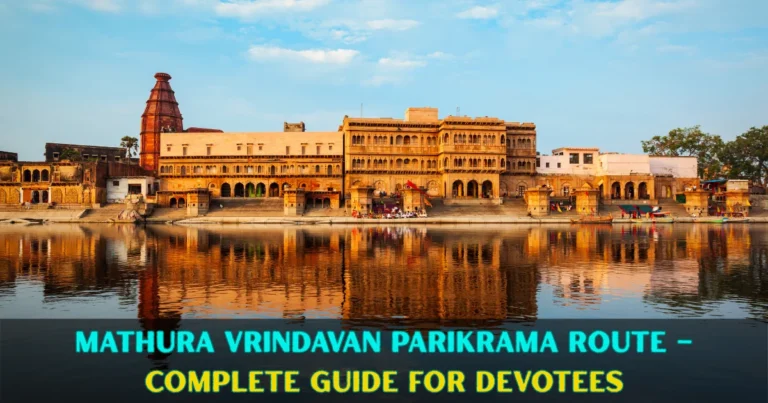
The Mathura parikrama path is different in its rhythm. Mathura carries the weight of stories much older, stories of Krishna’s birth, his childhood, his early steps in the world. The Parikrama takes you around Vishram Ghat, where Krishna is believed to have rested after defeating Kansa. The ghats of Mathura are unpretentious, yet they exude a profound stillness, and the river flows like she remembers everything.
On these ghats, the traveller proceeds to temples, which stand silently, each serving as a chapter of the Bhagavatam rendered in stone. The path flows through streets alive with motion (children running, vendors calling, scent of oil lamps wafting from open doors), and still, the Parikrama goes on, steady and placid like a prayer that goes on for ever.
Govardhan Parikrama Details
No guide to the Mathura Vrindavan Parikrama Route is complete without Govardhan. The Govardhan parikrama is easy to understand—go with patience, walk slowly, and let the hill speak to you. There are people who walk barefoot around the sacred hill, remembering that Krishna lifted it to protect the people of Braj. Along the Govardhan path are sacred sights like Jatipura, Mukharvind, Radha Kund, and Kusum Sarovar, all holding the aroma of an ancient miracle.
The Parikrama is long, but nobody complains. When devotion walks with you, the distance becomes light.
Vrindavan Temple Route
The Vrindavan temple route is a world in itself. Temples rise at every turn—some known to all, some hidden behind trees, some small enough to miss unless you walk slowly. Banke Bihari Temple, with its dark, gentle murti, holds the heart of Vrindavan. Radha Raman Temple glows with a warmth that feels older than time. Every temple has its own silence, its own rhythm, its own story that waits for the traveller to listen.
Parikrama Timings in Vrindavan
The parikrama timings in Vrindavan usually begin early in the morning, when the first light touches the trees and the air feels pure. Many devotees prefer walking before sunrise, when the world is still half-asleep and the wind carries a softness that only dawn can offer. Evening walks are common too, especially when the lamps begin to glow, and the sound of the temple bells floats through the lanes.
There is no fixed rule here. People begin when the heart tells them to.
Mathura Pilgrimage Guide
A Mathura pilgrimage guide is not only a list of where to go and when. It is a reminder to walk slowly, to pause at the ghats, to let the sun touch the river, to hear the temple bells without hurry. Mathura is not a place to finish quickly; it is a place to feel. Every step in this city feels like a return to something old, something remembered, something sacred.
Vrindavan Walking Route
The Vrindavan walking route is gentle. The path winds through temples, groves, and open courtyards where monkeys sit like old guardians of the town. The Yamuna flows quietly at the edge, and the air carries the names of Radha and Krishna with every breeze. Walking becomes devotion here, and the dust of Vrindavan feels like something worth holding.
Brij Parikrama Map
A Brij parikrama map can show you the path, but the land itself tells the story. The map only guides your feet; the journey guides your heart. Every turn, every tree, every shrine becomes part of the parikrama, and even the smallest corner of Braj feels touched by Krishna’s footprints.
Why This Route Matters
For those who travel with faith, the Mathura Vrindavan Parikrama Route becomes more than a circle of steps. It becomes a circle of devotion. A path where the heart grows quiet, where the mind becomes light, and where the traveller returns with something deeper than memories.
And for those who wish to walk this sacred journey with trust and simplicity, Mathura Vrindavan Temples stands as a gentle guide, keeping the stories of Braj alive for every soul that comes searching.
FAQs for Mathura Vrindavan Parikrama Route
1. What is the Mathura Vrindavan Parikrama Route?
It is a spiritual walking route that takes you around the sacred temples, ghats, kunds, and old lanes of Mathura and Vrindavan.
2. How long does the full Parikrama take?
Most devotees complete it in four to six hours, but the time depends on your pace and the crowd on the route.
3. Which are the main places covered in the Parikrama?
The route covers Govind Dev Temple, Banke Bihari Temple area, Keshi Ghat, Seva Kunj, and many small lanes filled with devotion.
4. What is the best time to start the Parikrama?
People prefer early mornings because the air is quiet, the crowd is less, and the temperature stays comfortable.
5. Do I need to take a token or permission for the Parikrama?
No token or permission is required because it is an open walking route for all devotees.
6. Is the Parikrama safe for elderly people?
Yes, it is safe, but the route is long, and some paths are uneven, so it is better to walk slowly and take short breaks.
7. Can I complete the Parikrama by vehicle?
Some parts allow e-rickshaws, but the true experience comes from walking through the sacred lanes.
8. What should I carry during the Parikrama?
Carry water, light snacks, comfortable footwear, and keep your belongings safe because the route gets crowded.
9. Is photography allowed during the Parikrama?
Yes, but avoid taking pictures inside temples or during aarti hours.
10. What is the best season to do the Parikrama?
Winter and early summer are the most comfortable seasons because the weather stays pleasant for long walks.